Kabbalah and Passover (Pesach)
The moment you realise that you don't have to stay the same as you are . . .
Passover, or Pesach, begins tonight, Wednesday 1st April 2026.
Traditionally, it marks the time the Israelites left Egypt but in Kabbalah it
becomes something much more personal than a biblical story. It’s about
leaving the places in our own lives where we feel stuck.
Pesach doesn’t fall on the same date every year because it follows the
rhythm of the moon rather than the Gregorian calendar. It falls on the 15th
of Nisan, Nisan being the first month of the spiritual year, the month of
miracles. It is the night of the full moon in Libra when the sun is in Aries.
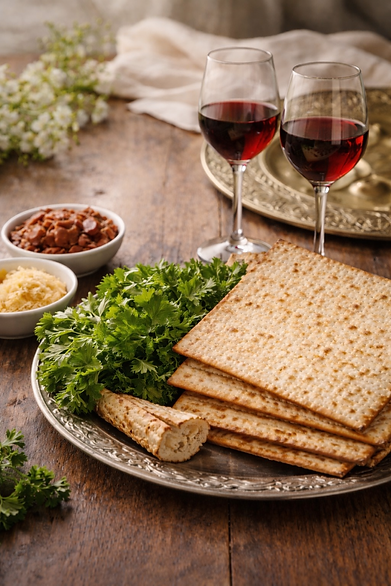
At sundown this evening, Kabbalists will share matzah, unleavened bread
symbolising humility and the loss of ego and limitation, alongside bitter
herbs to taste the constriction before freedom and to drink four glasses of
wine corresponding to the four spiritual worlds.
This continues for eight days, closing at sundown on the 9th of April.
It is a time when things begin to shift.
In Kabbalah, Egypt becomes something more than a place, it’s a state.
The Hebrew word for Egypt, Mitzrayim, means “narrow places,”where you
eel stuck in life or caught in repeating patterns. It reflects our ego and our
spiritual limitations and Passover is a time that shifts things energetically in
a profound way.
Kabbalah teaches that during this window, from sundown to sundown, a portal opens allowing a powerful light-force bringing an energy of renewal and freedom while highlighting where we are enslaving ourselves. This light releases resistance, allowing us to see things differently.
It’s a time when deep downloads of consciousness can come through, connecting directly to the soul and bringing clarity. So, something that has felt confusing for months might suddenly make sense or you may notice a shift in what you’re willing to tolerate. Sometimes it’s simply an undeniable truth, one you may have been ignoring or hadn’t fully seen, that tells you you can’t keep doing something the same way anymore.
The word Pesach translates as “to leap over.” It suggests that we don’t always have to work through everything step by step, but that we can move beyond something entirely. You don’t have to figure everything out or explain yourself to anyone, you can simply choose to make a change because staying where you are no longer feels like an option.
If you’re honest with yourself, there’s usually somewhere in your life that you’d like to change. It might be a situation you’ve been in for too long, a conversation you’ve been avoiding or a version of yourself that is staying smaller than you know you are. It’s not that you don’t see it, it’s that doing something about it feels like a risk and staying feels easier because it’s familiar.
But this time of year brings a different kind of question. Not “how do I fix this?” or “how do I make this work?” but simply: is this really where I'm meant to be?
And sometimes that’s all it takes. You don’t need a full plan or certainty, just that shift in awareness where you realise that you’ve outgrown something, even if you don’t yet know what comes next.
I keep coming back to an image of a corridor because it’s the closest thing I can find to what it feels like - Behind you is everything you know, even the parts that have been painful or draining. It’s familiar and that familiarity makes it feel safe, even when it isn’t. In front of you is something you can’t fully see yet, just a sense that there’s more, something different waiting, but without the details filled in.
And then there’s this moment in between, where you’re aware of both. You can see where you’ve been, you can feel that you don’t want to stay there but you haven’t fully stepped into what’s next either.
Passover feels like that moment.
Maybe that’s why it arrives in spring, when everything is shifting anyway. When the world itself is moving from stillness into growth, from darkness into light, not because we force it but because it’s time.
Passover creates an opening, a small but powerful one, where you can choose to move slightly differently.
Sometimes that will be enough. You don’t have to make a dramatic leap or a complete transformation overnight but a willingness to take one step away from what you’ve outgrown will change your direction. Once that shift happens internally, even if nothing changes immediately on the outside, you know something is different. And once you know, you can’t unknow it.
That’s usually where everything begins to move.
So if something feels like it’s shifting for you right now, I wouldn’t ignore it. You don’t need to rush it or force it into something it’s not but it’s worth paying attention to.
This isn’t just another moment in the year. It’s one of the few times where change doesn’t have to be hard, just recognise that you’re no longer where you used to be and allow yourself to move accordingly.
And this is where it becomes something you don’t just understand… but something that you actually work with.
In Kabbalah, Passover isn’t something you simply acknowledge and move on from. It’s about integration. It’s a time to be present to what’s actually happening within you.
There’s a clear distinction between the first 24 hours and the days that follow. The opening night, beginning at sundown, is considered the most potent part of the whole period. It’s described as a moment where the same Light that enabled the original exodus becomes available again, not symbolically but as something you can access now, in your own life, if you’re willing to meet it consciously.
Traditionally, this is marked by the Seder, a structured meal that most people know in a cultural or religious sense. But through the lens of Kabbalah, it becomes something much more interactive. Each element draws awareness to something specific. Matzah is deliberately simple, almost stripped back, representing a step away from the ego’s tendency to inflate and complicate. The bitter herbs are an invitation to acknowledge where life feels restricted or uncomfortable rather than bypassing it. And the wine expands consciousness, relaxing how tightly we hold onto things.
None of it is passive. It’s all designed to bring you into a different level of awareness.
Alongside this is the idea of removing chametz, which traditionally refers to leavened bread but in Kabbalistic terms, goes far beyond food. Chametz represents the parts of us that rise up unnecessarily, our reactivity, ego, the need to be right, the tendency to make things heavier than they need to be. The practice becomes one of noticing where you’re reacting instead of responding, where you’re tightening instead of allowing and catching those moments as they happen.
This first 24-hour window is often where people talk about “downloads” or sudden clarity and when you understand it this way, it makes more sense. It isn’t that something external is being given to you, it’s that something internal becomes visible. Patterns you’ve been in for a long time can suddenly feel obvious. Decisions that felt complicated can feel simple. You may find yourself seeing a situation, or even yourself, in a way you hadn’t been able to before.
The rest of Passover, up until the evening of 9th April, isn’t about maintaining a heightened state, but about integration. It’s about what you do with what you’ve seen.
Kabbalah places a lot of emphasis on “restriction,” meaning the ability to pause before falling into the same automatic patterns. It’s about noticing the moment where you would normally react and choosing, even slightly, to do something different.
This is where things tend to show up again, but not in the same way. It’s almost as if life gives you another opportunity to meet the same situation with a different level of awareness. Not to test you but to allow you to respond differently this time.
There’s also something important about staying connected to whatever shifted during that first opening. It’s very easy to have a moment of clarity and then drift back into familiar ways of thinking or behaving. This part of the process is about not closing that door again. Not forcing anything, but holding onto the awareness that came through and letting it inform how you move forward.
One of the deeper ideas within this period is to begin living as if you’ve already left Egypt, recognising that even if nothing has changed externally yet, something in you has. And once that internal shift has happened, the old way of being doesn’t quite fit in the same way anymore.
And maybe this is where certainty comes in.
In Kabbalah, certainty is a big word. It isn’t about knowing exactly what will happen next, it’s about trusting that something is already moving, even if you can’t yet see it.
So as the sun sets this evening, let go of the need to control the outcome and allow something new to come in—trusting that it’s already guiding you towards a different version of yourself.
And if it helps, you can even visualise yourself leapfrogging out of the old outfit and into the new!